Showing posts with label World Unity. Show all posts

Thursday, 23 July 2009

Tragedy!

One of the best traditions in politics has been destroyed by the nefarious Singaporeans and their hatred of laughter and smiles. The ASEAN summit, rescheduled in Phukhet after the protests earlier in the year ended it prematurely, will no longer be keeping with its tradition of having foreign ministers and various other political magnates perform what can only be called fabulous skits, under fairly close guard from media attention. Some highlights that have emerged over the years:

1997: The Australian delegation dresses up like "Men At Work", and sings their only hit, "Down Under", to a horrified audience.

1998: Russian and US delegations dress up as Jets and Sharks in a re-enactment of West Side Story, in what is meant to be a light-hearted parody of the Cold War, but is in effect an admission of defeat to the capitalist US Broadway hegemony.

2000: European delegation revisits ABBA favourite, singing "Knowing Me, Knowing EU"

2001: US Secretary of State Colin Powell kisses Japanese Foreign Minister Makiko Tanaka whilst performing "El Paso", clearly misunderstanding the preferred sexual orientation of past ASEAN performances.

2004: Powell (pictured above) gets it right by performing "YMCA" in a builders outfit and not kissing a woman.

2005: Perhaps the best of the lot, Russian Foreign Minister Sergey Lavrov (pictured left) inexplicably dresses up as Darth Vader, and swings a plastic lightsabre while singing "Jesus Christ, Superstar" in front of a map showing the US as "East Asia". If anyone can find a video of this, please let me know.

2006:Also one of the best, Japanese Foreign Minister Taro Aso (Now Prime Minister of Japan) impersonates Humphrey Bogart while behind him members of the Japanese delegation dressed up in sumo wrestler fatsuits, Ultraman costumes, Ultraman villain costumes, and koi carp meander about. Video below.


2006: Also awesome, South Korean Foreign Minister Ban Ki-Moon (Now Secretary General of the UN) dresses up in a green-sequin jacket and sings ABBA again. Again, if anyone can find this on video, please let me know. It's important.

2007: Taro Aso again gets his delegation to dress up in samurai costumes and sumo fatsuits, and leads them in a choreographed dance thing.

And now it's all over.

Friday, 3 July 2009

Hell Hath No Fury Like Hentai Scorned

The ridiculous Chinese "Green Dam" internet censorship drive has sparked outrage in the vast community of hentai consumer/producers, who have lashed out by creating Green Dam Girl, a satirical portrayal of the Chinese government's anti-pornographic policies. Ironically (inevitably), Green Dam Girl is Dam Hot (oh dear).
Green Dam Girl has become extremely popular.

Words such as "heresies", "essence" and "cult" have been banned from google searches by the Green Dam software, unintentionally making Warhammer 40,000 unplayable in China.

Even the Chinese government has acknowledged Green Dam Girl's popularity, noting that "the sentiments of the people seem to be in accordance with international feeling".
Green Dam Girl is in favour of international feeling.

Monday, 22 June 2009

Something Long On Iran

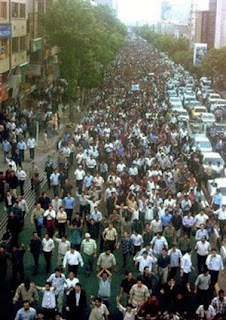
Below is an extract from Roger Cohen's opinion piece in The New York Times, recounting his experience walking through Tehran during a recent anti-government protest.
"Can't the United Nations help us?" one woman asked me. I said I doubted that very much. "So," she said, "we are on our own."
Almost everyone has been following the unrest in Iran over the past few weeks. For those following it closely, it started with the pre-election hope that the Iranian president Mahmoud Ahmedinejad might be supplanted by the slightly more moderate Mir Hussein Moussavi. As we know, that didn't happen, and Ahmedinejad claimed victory in a supposed landslide, defeating Moussavi by a wide margin across the country, even in Moussavi's own home town.

It was the brazen and condescendingly shoddy electoral fraud that sparked the protests, which began merely as demands for a recount, or at least some sort of accounting of the election. But the government decided to start a shoving match with its riot police and the Basij, unofficial paramilitary squads charged with either beating protesters or impersonating them to commit arson, creating an aura of chaos the government can capitalise on to justify the imposition of brutal order.

I think, if we're honest, most of us expected the Iranian "velvet revolution" to die down after a few days of student protest, defused by the conscientious government application of violence along with calls for compromise and moderation; the classic carrot-and-stick approach. But the protests have stretched and grown, and as pixelated images and feeds of protests keep surfacing, the drama, the stakes, and the potential of this uprising have persuaded a much larger audience than third-world unrest usually does.

A YouTube video surfaced yesterday showing an Iranian girl, shot in the heart, dying on the street, full of blood. It was obscene in both content and context, a click and a half away from the cutest Welsh Corgi taking a bath in a sink. It's upsetting and it should be; I'm glad that YouTube, Twitter and Facebook have become the most important outlets for information on the situation in Iran. The media have been calling it "citizen journalism", but that has too many connotations of amateurishness and unaccountability. They don't pretend to analyse, or present a whole, unbiased report of the situation. I think its function is more simply to witness, a globalisation of witnesses which enables us, however imperfectly, to draw a lens on events normally out of sight.

I'm glad that the uprising has achieved (and it is an achievement) so much international attention, because Iran should not be on its own. The impotence of the UN in the face of the quoted woman's appeal is intolerable. She believed that domestic injustice is an international affair, and she's right. There are no convincing arguments for the principle of non-intervention. There are costs, and risks of course. The international community should be wary of intervening in a crisis it doesn't understand, or where its intervention would be counterproductive.

But the international community also has a mandate to endeavour to understand foreign crises, and engineer interventions that aren't counterproductive. This is a moral mandate which overwhelmingly trumps the legal mandate not to intervene, solidified through centuries of moral barbarism and intellectual dishonesty. Conventions established when "racism" and "empire" were open adjuncts to "stability" and "empire" should have no hold over us today.

The Iranian uprising might or might not have its back broken by the state, still capable and possessed of a gnashing determination to survive. Either way, the rest of the world won't have helped much. It seems naive to even speak of a global will to intervene when Russia and China hasten to congratulate successful sham elections and militate against UN criticism of state brutality. But what this moment should tell us is that however foolish, risky or ingenuous speaking might be, there is yet something to speak of.

Tuesday, 28 April 2009

Our Enemies All Along

We've been eating them for millennia, and now the pigs are wreaking vengeance on Mexico, parts of the USA, and Canada. Over 149 people have been killed by swine flu, and panic is spreading fast. The virus, which is actually a hybrid of swine, avian and human strains of influenza, has mutated and can now be transmitted between humans, as opposed to being limited to pig-human contact. 

One of the most interesting things about the current panic, apart from the fact that we're all going to die squealing while the pigs laugh in mocking human tones (which is admittedly quite interesting), is that you can literally see the panic spreading by refreshing newspages online and seeing words like "concern" become "worry", and finally "terror"

You can even see it in the responses of the experts and administrators who we look to for guidance when mutated strains of hybrid pig-virus start leaking across our borders. 

Richard Besser(Head of the Centres for Disease Control): "As we look for more cases of swine flu, we are seeing more cases of swine flu. We expect to see more cases of swine flu."

and

Keiji Fukuda (WHO assistant director general): "The situation is fluid and the situation continues to evolve."

and also 

Sandra Mournier-Jack (London School of Tropical Medicine and Hygiene): "We should be, in a way, more alarmed, but at the same time we shouldn't panic because there a lot of things we don't know about this disease at the moment."

God help us all.

Sunday, 5 April 2009

A Politic Blunder Feature: G20 London


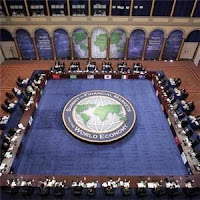
The G20 Summit here in London finished two days ago, amid much feigned interest, mild controversy and even milder actual interest. Almost the textbook definition of what is normally considered a stereotypical political talking shop, by virtue of the extraordinary circumstances, was actually a fairly big deal. 
                                            
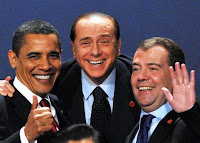
The festivities (no, wait, what's the opposite of festivities?) took off in style with President Obama meeting Queen Elizabeth II, and soliciting his wife to manhandle her. Thereafter Mr. Berlusconi made a fool out of himself by doing his best Little Rascals face between Mr. Obama and Mr. Medvedev, seen left gesturing wildly at their respective secret service snipers. 

The actual summit was surprisingly productive. The focus was more on saving capitalism rather than reforming it. Lots of money was given to the IMF (amounting to about $750 billion) ostensibly to pass on to developing countries in loans. Fantastical amounts of money were accounted for fiscal expansion (that is, the government spending more money on programmes and projects, often to create jobs where the private sector is cutting them), amounting to over $5 trillion. 

Talk of actually reforming the financial system was thin on the ground, with resolutions to begin to monitor "systemically important hedge funds", and to begin to regulate excessive leverage. There wasn't much commitment on international standards on finance either, beyond a token dictum on the importance of "internationally agreed high standards", and changing the name of the Financial Stability Forum (FSF) to the Financial Stability Board (FSB), which will have the exact same members, with no indication of any specific change in function. 

In terms of politicking, in brief: The USA wanted less regulation and more funds to support fiscal expansion, Europe wanted more regulation but dragged its feet on the money. The G20 was very shrill about its commitment to the developing countries, presumably to make up for the fact that no strategically unimportant poor countries were allowed to attend. 

Everyone agrees that the world is going to hell in a handbasket for one reason or another (This man's been predicting it with frightening regularity and speed for a while now). This is exactly why the G20 summit was a good thing, and why it's important that people recognise that it is a good thing. 

Expanding the realm of substantive international policy-making from the G7 to the G20 is a wonderful thing, even if there is still an enragingly long way to go. Conferences such as these actually work, too. Pledges were made, and though they probably won't be followed through on completely, funds will be raised and legislation will be written. Politics isn't a technical exercise, there are hundreds of degrees between failure and success, and it's in those spaces that progress is made. This isn't rocket science. It's much harder.

Wednesday, 25 February 2009

NGO Unable to Make its Peace with Global Oppression

Human Rights Watch, a New York based NGO you may have heard of, has been hitting the news pretty hard lately with two of its particular brand of well-researched, voluminous condemnation.

The organisation firstly condemned Syria's Supreme State Security Court, set up in 1968 to assist the regime in wiping out Communism. The court has since been used the court as an instrument to try people on behalf of the state, rather than the people, and the HRW accuses it of gross violations of justice including torture and limited access to lawyers. 

Another high profile condemnation, at least in the African press, has been that of the Angolan electoral system. Angola has just had parliamentary elections this past year, which many (notably the HRW) criticised for being if not rigged, then severely problematic. The HRW has optimistically called on the Angolan president, Jose Eduardo dos Santos, to fix the problems prior to the presidential elections in 2009.

The HRW does stuff like this literally all the time. They have a broadly symbiotic relationship with Amnesty International, which handles human rights as well but focuses more on mass mobilisation. When reactionary dictators and their apologists clamour that Amnesty International is a poorly researched mouthpiece that is exaggerating the condition of oppressed peoples, Human Rights Watch is there with a 270 page report evincing in excruciatingly monotonous detail that things are really, seriously, verifiably shit.  

If you want to peruse their reports on Syria's SSSC or the Angolan electoral system, go here and here, respectively. They both have pretty concise executive summaries, which makes it a bit easier for all of us.

Monday, 2 February 2009

SNOW DAY!

We interrupt A Politic Blunder's usual cutting edge reportage to bring you fantastic pictures of London completely covered in snow! Genuinely the prettiest the City has ever looked. Children have made a snow-man on my street that has a bowler hat! And a note thanking Russia for their winter snow!

The entire city seems to have shut down. LSE has cancelled all lectures and seminars, and I think the phone lines at SOAS have actually shut down cause I can't even get through to find out what's going on there.


And what's more, it's still snowing! Experts say that they love spending time with their loved ones on snow-days. So if you're reading this and it's actually still snowing outside, then go outside and make a fucking snow angel, or throw a snowball, or bury your dead. 

Seriously, a snow-day would solve all of Sri Lanka's problems.

Monday, 26 January 2009

Politic Blunder Boycotts BBC

Long-time readers will remember that I have had my problems with the BBC news service in the past. The kinds of stories they choose to cover venture dangerously close to tabloidism, as does their treatment of more serious issues. 

The issue of the Disasters Emergency Committee ad not being aired reaches another level, though. As many of you will have heard, the BBC chose not to air an ad by the DEC asking for donations to provide blankets and other basic supplies to the victims of the recent Gaza conflict. The BBC have aired many DEC ads before for other crises, but have refused to air this one for fear of "giving the public the impression that the BBC was taking sides in an ongoing conflict" (in the words of BBC head Mark Thompson, an overweeningly arrogant ignoramus).

That this is a ridiculous stance to take is obvious. The DEC is a humanitarian organisation composed of such members as the Red Cross, World Vision, and Oxfam, and the ad is distinctly non-political. By not showing the ad, it is the BBC that is taking an explicitly political stance, in that they are concerned that Hamas might possibly benefit from schools being built in the areas they control. 

For these and other reasons, Politic Blunder will be boycotting all BBC news sources for exactly one year, at which point it will be subject to review. This means that I won't be visiting any BBC websites, and I will not intentionally watch any BBC televised programming. 

If any of you want to donate to the DEC for Gaza relief, go to this website: DEC

Alternatively, the address is:
DEC Gaza Crisis
PO Box 999
London EC3A 3AA

If you want to read the infuriating text of Mark Thompson's attempt to justify his "moral cowardice" (in Bill Bailey's apt words), go here.

If you want to see a haplessly retarded BBC newsreader trying to justify a decision she's too stupid to have an opinion on to aged British socialist Tony Benn, go here.


Saturday, 17 January 2009

No But Seriously, Though. #2

Pictured left, Israeli Foreign Minister Tzipi Livni and the US Secretary of State Condoleezza Rice in the moment of delectably unbearable sexual tension before a passionate Sapphic embrace. This interracial gay kiss will undoubtedly spark the ire of Muslims and lesbian nuns in crotchless habits, diverting attention away from both the brutal Gaza occupation and the upcoming Republican handover of power. 

More speculation on the ramifications of lesbian love at the highest levels of politics in upcoming, better funded editions of Politic Blunder.


Tuesday, 23 December 2008

MSF Releases Top Ten Humanitarian Crises List


Medecins Sans Frontieres has released their annual list of the ten most underreported humanitarian crises in the world. In the spirit of giving these crises a bit more exposure, I'll reprint the list here with a few comments. What's good about this list is that it specifically avoids the temptation of numbering them on an ascending scale of importance. It's difficult enough to draw attention to unsexy and unexciting humanitarian issues, but it would be equally unhelpful to start a "countdown" to the "number one most underreported humanitarian crisis". 

Somalia
Somalia's humanitarian catastrophe has been chronic and pervasive. The entire country essentially disintegrated years ago in 1991, and for a long time the only semblance of order the country found was in the fundamentalist, milita-enforced rule of the Islamic Courts of Justice, until they were ousted by Ethiopian troops. The country is basically off limits to international aid agencies because no one can guarantee them even a provisionally safe environment in which to deliver aid.

Ethiopia
Neighbouring Somalia, Ethiopia is not doing  much better. The population is largely nomadic, and combined with tensions between rebel and government groups and an incipient civil conflict, delivering aid to this incredibly poor country has become very difficult. This is one of those examples where there has been no catalyst, no major newsworthy event that can be used as a lens through which to see the poverty of the country. Instead a series of boring and complex structural factors contribute to the suffering of Ethiopia's people, relegated to anonymity with the occasional exception of a "special report" in the news.

Myanmar
In May this year, the typhoon that wrecked much of Myanmar dominated the news very briefly. What was equally important at that time was how the military government was completely blocking off a lot of foreign aid that the news coverage of the crisis spurred. Several months on, the situation has returned to a semblance of normalcy, and so Myanmar has once again been forgotten. Normalcy, though, in the case of Myanmar, means destitution and crushing military rule. There is a full blown AIDS epidemic in the country, with over 75 000 people needing anti-retro viral treatment, yet the country has the lowest amount of foreign aid per capita in the world.

Zimbabwe
See previous articles on the topic. But just to add to the chorus, because of the appalling health situation there (especially the prevalence of AIDS), the UN found that the country now has a life expectancy of 34 years.

Democratic Republic of Congo
This again is a crisis that has been fairly well reported, but consistently remains second- or third-tier news. The renewed fighting in the eastern portion of the country, spurred by a dickhead warlord Laurent Nkunda, has caused massive displacement and dislocation of thousands of villagers. Without even mentioning the deaths, the child soldiers, the cholera and malaria outbreaks due to nonexistent sanitation and healthcare, this situation pushes hopes for any sort of progress for the country far into the future. 

Pakistan
The federally administered tribal areas in Northwest Pakistan, bordering on Afghanistan, have long been problematic for the country's security situation, as their goals are sharply opposed to the modernising government of the country. The resulting clashes, combined with the proximity to Afghanistan, brings conflict, poverty, the Taliban, and US explosives onto the scene. The whole area is basically the USA's battleground, so MSF and other NGOs have understandably found it difficult to provide aid and services.

Sudan
The situation in Sudan has been fairly well depicted in the media, despite excessive obsessing over the possibility of "genocide" in the region. What is more pressing than the questionable assertion that concerted ethnic cleansing is going on is the complete lack of infrastructure, stability, or security in Darfur, and the constant spasms of violence that wrack the region. The world's largest humanitarian operation is in place there, but the needs of Darfuris far outweight the services provided. 

Iraq
Iraq has truly become a third world country since 2003, subject to a systematic dismantling of first its government (with the US-led disintegration of the Baathist state following the war), then the economy (with the massive internal displacement and complete lack of security which makes planning and investment impossible), and finally, society (with the USA playing Shia, Sunni and Kurd factions against each other). 

Childhood Malnutrition
This is really a deceptively vital problem, and I didn't really consider it before I read the report. 178,000,000 children worldwide suffer from severe malnutrition problems. The tragic thing about this in particular is that malnutrition as a child stunts your prospects as an adult. It causes mental and physical problems which go on to replicate themselves in following generations. A starved child will grow up into a weak and dull-minded adult, who will be less likely to provide food for his or her children. Ensuring that children get enough food is such an incredibly basic thing, and it definitely requires more attention.

HIV/TB Co-Infection
The AIDS pandemic has been widely reported on and recognised. An important link that MSF emphasises is that between Tuberculosis and AIDS. TB is the most frequent killer of people with AIDS, and it is especially prevalent in countries which happen to have high incidences of AIDS, which is the reason countries like Botswana and Zimbabwe have life expectancies of 37 and 34, respectively. AIDS does more damage than the sum of its parts, as well, since the deaths fall disproportionately on the sexually active, which happen to also be the productive adults in society, leaving societies populated entirely by children and the elderly. 

It's easy to be overwhlemed by all this suffering and seemingly ingrained conflict crisis. But as a starkly editorial comment, I want to exhort both my readers to seriously, seriously not give up. Good work is being done, and the mere recognition of these problems is a step forward, not an admission of defeat. 

To view the excellent MSF feature on this, which has a lot more facts and a lot less opinionated rhetoric, go here.

Saturday, 29 November 2008

The World Is Still Round


To finish up catching up on the week's news, Politic Blunder will do one better and look at people predicting the future. It is a tradition at The Economist  to print an issue at the end of the year with lots of well-informed predictions about the coming year. This £5.50 issue is worth a place in your toilet, as it has a lot of useful and nifty financial information and some interesting articles written by world leaders, CEOs, and Third World presidents.

The real reason to get it, though, is the predictive articles themselves. Some snippets from The Economist's perfected the art of self-evident prophecy:

-In Iraq: 'Arguments over the pace of American withdrawal will persist'
-In Australia: 'The world's second-dryest continent is running out of water'
-In Africa: 'A better future for sub-Saharan Africa depends on better policies'
-In the USA: 'Obama will have to learn how to say no'

In 2009, women across the world will have to learn to say no to me, but will be inexplicably unable to. 

Wednesday, 5 November 2008

A Mythic Hope and a Brightening Dawn - A Politic Blunder Feature

I can think of few people who last night were not nailed to the front of their televisions, or nervously clicking the refresh button over and over, or drinking to excess. I was doing all three. Obama's election means a lot to black Americans, and it means a lot to the soldiers in Iraq, on either side. The internet has been awash with testimonies and open letters to this effect. But it bears a special and separate significance to the rest of the world. Obama gave us a short few lines at the closing end of his speech, affirming that we had a shared destiny, with the caveat that it would be under a 'dawn of American leadership'. 

So what fate the billions of non-Americans who hope for not just a change within America, but a change between America and the rest of the world? I am but one small Italian student in London, ostensibly with no stake or power in the events that shape the so-called 'Leader of the Free World'. Obama's presidency means first and foremost the end of the Bush era. Neoconservatism, John Bolton's psychotic proclamations of the primacy of US interests 'above all else', two destructive and unsuccessful wars, and an unhealthy redolence of the Cold War with China and Russia. These were all hallmarks of the Bush doctrine, and we can hope to see these things disappear from American discourse under a successful Obama presidency. America has long been aware that the world despises it, but it is now becoming aware of the fact that this matters

Obama is a thoughtful man, and one who clearly prides himself on his intelligence, which is more than can be said for either Bush or the Republican candidate. This, along with his rhetoric of change and his policy promise of negotiations without preconditions mean that we can look forward to a USA that engages with the world more as a participant in the world community, rather than regarding us as either accomplices to their interests or terrorists. Obama's affirmation that this new dawn was one of American leadership was politically inevitable, but it remains disappointing. America should not have to rely on its sense of entitlement and exceptionalism for its identity. I believe we may see change in this direction in the next four years.

Almost as intense as the optimism and hope that swelled following news of Obama's victory was a hard knuckle of cynicism and doubt. You can always count on some pundits to try to take a negative spin on any overwhelmingly hopeful and positive turn of events just to appear more nuanced and sophisticated than those poor naive who truly believe things are worth being happy about sometimes. These commentators point to the huge problems the world still faces. The continuing wars in Iraq and Afghanistan, the continuing shitstorm in Sub-Saharan Africa, and a big fuckoff financial crisis that has everyone not only scared for their lives and livelihoods, but collectively embarassed by how little we understand about the forces that control our homes and our markets. 

The pundits are idiots to be cynical about Obama. If anything, we should be more hopeful and optimistic that this kind of starkly positive change happened right when the world truly needed it. Of course no one expects Obama to actually be a messianic figure that will solve world poverty and beat Osama Bin-Laden at Street Fighter Alpha 3. But everyone who is genuinely happy that Obama won and thinks that things will get better from now on is far better an analyst of political opinion than either the grim naysayers of the high-minded broadsheets, or Gore Vidal.


Friday, 26 September 2008

Bono + Brown vs. The French

This week has seen one of the worst financial crises in recent memory, according to econo- mists, bankers, and other slick big-towners. Everyone is talking about 30% increases in the price of food, the dearth of loan opportunities, and events like Lehman, the 4th largest investment bank in the US, filing for bankruptcy have basically confirmed the 'hell in a handbasket' diagnosis. Amidst all the squealing issuing from the Western world, what is of most concern to the folks at the United Nations is that Western countries do not renege on their promises of aid to developing countries. French Foreign Minister Bernard Kouchner stated that he thought that it was 'a bit unfair' for starving, AIDS-ridden African countries with shattered economies to be asking the richest countries in the world to honour commitments they made to give aid. This sentiment has been echoed elsewhere in the developed world, though only the French had the audacity to get their most senior diplomat to essentially give the finger to two-thirds of the world.

Much like the armies of Saruman bringing forth the cave troll to assail the mountain fortress of Helm's Deep, UN Secretary General Ban Ki-Moon (pictured above in his Kofi Annan costume), has brought out the big guns by unleashing Bono on the French. 'The last few days have re-injected momentum that must sweep on' Bono opined. 'Even in these tough times, this historic promise has never been more important to keep.' Slightly less eloquent was senior statesman Gordon Brown, who added 'This would be the worst time to turn back.' The French have not been contacted concerning a reply, but it is safe to say they would not dare turn their sharp Gallic tongues on the messianic Irishman.

Ban Ki-Moon is currently asking for $72 billion in aid every year for the next ten years, in a program he claims has the ability to win the war on poverty. He cited the great success of attempts to eradicate malaria in Africa as evidence that the continent is more than just a cash-sink. The fact that in the midst of one of the financial panic there are still loud voices calling for increased aid to developing countries is something to be proud of. Foreign aid, especially to sub-Saharan Africa, has traditionally been at the very bottom of the priority list of most budgeting legislatures.  But we have seen a steady increase in the amounts of aid promised by G8 governments, and although there is a worryingly large discrepancy between this figure and the amounts actually delivered, political will is a genuine precursor to actual policy. Africa will not be receiving $72 billion this year. No one thinks that. The World Bank on Thursday promised just $1.1 billion to continue efforts to eradicate malaria in Africa. But we are still seeing real progress.

Tuesday, 23 September 2008

Forget Chocolate

Today Thomas Doerflein, celebrity zookeeper, died in undisclosed circum- stances, aged 44. The German skyrocketed to fame after he adopted a small polar bear after its mother rejected it. Naming it Knut, he then proceeded to spend 150 days giving it round-the-clock attention, food, and life affirming talks. The bear and his keeper became celebrities after it was discovered that polar bear cubs are incredibly cute. Doerflein's shows where he would cuddle the bear and talk to it the same way people talk to babies attracted audiences of over 1 million.

Most importantly, though, is that Doerflein became an international sex symbol following his selfless acts. Not only was he rugged and bearded, but sensitive and passionate about animals. Women's knees were sublimating everywhere. He was sent reams of love letters  and leering young women would often catcall 'Knuuut! Knuuuut!' at him while he walked by. The ingrate Thomas Doerflein refused to revel in either media or female attention. But you've heard it here first, lads. You say it best when you say it with an infant bear. We show Mr. Doerflein due respect for being one of the pioneering players of our times, and for giving us a wonderful new way to score the ever-elusive 'political activist ass'. I salute you, sir, truly you are a Polar Pimp.

Friday, 19 September 2008

Just Keep Talking...

The Iranian Nuclear Saga enters its latest chapter today as France, Britain, Germany and the USA began talks concerning the imposition of a fourth round of trade sanctions on Iran, in order to force it to stop uranium enrichment. Russia and China have not been invited to the talks, on the assumption that they will only contribute smug grins and akimbo intransigence. A USA State Department spokesman, Sean McCormack, has stated that he 'would not set expectations high at all for this meeting actually producing a definitive answer', which begs a few questions. The talks offer trade bonuses if Iran cooperates, as well as sanctions if it fails to comply. 

An IAEA report earlier this week complained that the Iranian authorities had 'stonewalled' their efforts to determine whether Iran's nuclear program was for civilian or military purposes. Mahmoud Ahmedinejad, of course, maintains that the IAEA investigation was unobstructed, and that the nuclear program has only ever been for civilian use. The talks are about putting more pressure on Ahmedinejad, already unpopular in Iran. Using the UN to put pressure on recalcitrant states is much more effective than the unilateral, gunpowder-flavoured pressure the USA usually prefers. Iran is being presented with a choice between being brought into the international community and participating in talks, or remaining a pariah, however unjustifiably. The USA's refusal to engage Iran in talks until uranium enrichment is halted is a good thing. No one should deny Iran the right to civilian nuclear power, but it must be willing to take whatever steps necessary to assuage a rightly nervous world. Evidently the USA has better people working in New York than in Washington.

Friday, 12 September 2008

A Ban on Laziness


UN Secretary General, Ban Ki-Moon(pictured left), has publicly chided the UN for being too lazy, managerially inefficient, and opaque. 'There is bureaucracy...and then there is the UN', he said at a news conference today. The UN has long been derided, especially by the US, which provides much of the UN's funding, as being inefficient and a waste of time and money. Ban entered the highest position in the UN on a platform of reform and streamlining, a realistic, moderate turn after Kofi Annan's lofty goals. 

It is not difficult to see why Ban Ki-Moon is frustrated. Coming from a culture that espouses diligence and the importance of bureaucracy, Ban now has to deal with one of the most bloated organisations in existence, a haven for sinecure 'sub-committees' and fruitless talking shops. Ban Ki-Moon's goal of seeing the UN 're-energised, re-charged and full of motivation and full of creativity and versatility' is a noble one. Newspapers and UN spokespeople who accused Ban Ki-Moon of admitting failure are missing the point. It is not about admitting failure, it's about being disappointed with a lack of progress.

Another comment of Ban's that was taken out of context was during his speech on August 29, where he stated 'I tried to lead by example. Nobody followed.' Critics have been declaring this an admission that Ban Ki-Moon lacks authority. Perhaps they should remember that Mr. Ban also comes from a culture that encourages kicking people in the face.