Showing posts with label Middle East. Show all posts

Friday, 17 July 2009

But Are They Jewish ENOUGH?

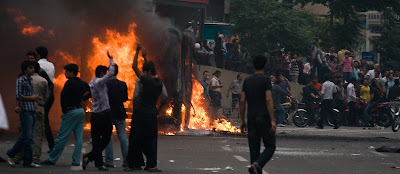
Two seperate slices of stupidity from Israel today. Firstly, violent demonstrations by ultra-orthodox Jews (also known as ultra-Jews) have caused chaos in Jerusalem, burning tires and rubbish bins and throwing rocks at riot police. The hubbub was caused by the arrest of an ultra-Jewish mother who apparently starved her 3-year-old child, as she has Munchausen Syndrome by proxy (Consult House for an awesome explanation). The ultra-Jews were upset that one of theirs was arrested, and reportedly think it's impossible for an ultra-Jewish mother to commit such a crime.

Although seeing hundreds of people protesting violently in snappy suits and hats is undeniably a sight, it's just stupid to start riots because a member of your community got arrested.
Secondly, the Israeli government is deciding whether or not 3000 Ethiopians are actually Jewish or just pretending. This absurd practice derives from the fact that Israel is legally a Jewish state, even though it's also supposedly secular. This means that Jews immigrating automatically get citizenship if they want it. This puts the Israeli government in the position of judging whether someone is really Jewish or not, regardless of what they say/believe. It's unclear what ridiculous standards Israel is using to quantify "Jewishness", but it probably includes nose-measuring and joke-telling.

The sheer arrogance of a state purporting to decide for someone else what religion the "really" belong to is mind-boggling.

Monday, 13 July 2009

Oh Wait, Nevermind

Goldman and Sachs (pictured above), the prominent Wall Street bank, has posted that it is likely to have made $2 billion profits in the March-June period. That's $2 billion profits, above and beyond the rest of the money they spent to run their unholy operation. They're posting estimates for their profits from March through June, which means they literally have more money than they can count. I don't know how much money I have either, but that's just due to the subliminal terror I have of checking my current account that impels me again and again to press "No." when offered a receipt at cashpoints. And Goldman and Sachs made $2 billion in profits since March.

Happy Monday, everyone.

In other depressing news, the Honduran coup that ousted Manuel Zelaya and instated serial coup-monger Roberto Micheletti is not at all likely to be overturned. The OAS has not yet accepted Micheletti, but it will probably only hold out for another week or two before "starting talks", implicitly recognising that Micheletti is now the de facto, and soon de jure leader of the country (Official Politic Blunder prediction).

Let's not even get into Iran, which major news outlets have pretty much completely stopped reporting on. This was only to be expected, as the thrill of having absolutely no news to report because of the total media blackout imposed by the government gives way to the realisation that there is absolutely no news to report. But like I said, I'm not going to get into Iran.

Television holds no solace either. Pakistani MTV was showing a really bad band fronted by an ugly woman ripping off Evanescence's "Everybody's a Fool", a really bad song, down to the last note, really badly.


Clearly Evanescence must have known about this, and sold them the rights to their song (and soul). Which is almost worse than coups in Honduras and brutal government repression in Iran. Almost.

Returning to the issue of Goldman and Sachs, Rolling Stone columnist Matthew Taibbi described Goldman as "a great vampire squid wrapped around the face of humanity, relentlessly jamming its blood funnel into anything that smells like money." The hilarious thing about this is that Goldman didn't dismiss this as a malicious characterisation or metaphor, but as a conspiracy theory. Which means they're seriously worried that people might start thinking that's actually how they make $2 billion in profits in 3 months.

Which would make more sense than all this "derivatives" and "risk management" hocus-pocus they keep foisting down our throats.

Monday, 22 June 2009

Something Long On Iran

Below is an extract from Roger Cohen's opinion piece in The New York Times, recounting his experience walking through Tehran during a recent anti-government protest.
"Can't the United Nations help us?" one woman asked me. I said I doubted that very much. "So," she said, "we are on our own."
Almost everyone has been following the unrest in Iran over the past few weeks. For those following it closely, it started with the pre-election hope that the Iranian president Mahmoud Ahmedinejad might be supplanted by the slightly more moderate Mir Hussein Moussavi. As we know, that didn't happen, and Ahmedinejad claimed victory in a supposed landslide, defeating Moussavi by a wide margin across the country, even in Moussavi's own home town.

It was the brazen and condescendingly shoddy electoral fraud that sparked the protests, which began merely as demands for a recount, or at least some sort of accounting of the election. But the government decided to start a shoving match with its riot police and the Basij, unofficial paramilitary squads charged with either beating protesters or impersonating them to commit arson, creating an aura of chaos the government can capitalise on to justify the imposition of brutal order.

I think, if we're honest, most of us expected the Iranian "velvet revolution" to die down after a few days of student protest, defused by the conscientious government application of violence along with calls for compromise and moderation; the classic carrot-and-stick approach. But the protests have stretched and grown, and as pixelated images and feeds of protests keep surfacing, the drama, the stakes, and the potential of this uprising have persuaded a much larger audience than third-world unrest usually does.

A YouTube video surfaced yesterday showing an Iranian girl, shot in the heart, dying on the street, full of blood. It was obscene in both content and context, a click and a half away from the cutest Welsh Corgi taking a bath in a sink. It's upsetting and it should be; I'm glad that YouTube, Twitter and Facebook have become the most important outlets for information on the situation in Iran. The media have been calling it "citizen journalism", but that has too many connotations of amateurishness and unaccountability. They don't pretend to analyse, or present a whole, unbiased report of the situation. I think its function is more simply to witness, a globalisation of witnesses which enables us, however imperfectly, to draw a lens on events normally out of sight.
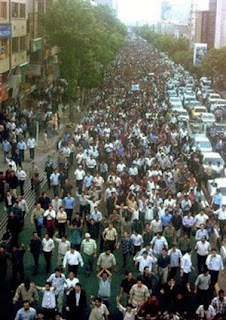
I'm glad that the uprising has achieved (and it is an achievement) so much international attention, because Iran should not be on its own. The impotence of the UN in the face of the quoted woman's appeal is intolerable. She believed that domestic injustice is an international affair, and she's right. There are no convincing arguments for the principle of non-intervention. There are costs, and risks of course. The international community should be wary of intervening in a crisis it doesn't understand, or where its intervention would be counterproductive.

But the international community also has a mandate to endeavour to understand foreign crises, and engineer interventions that aren't counterproductive. This is a moral mandate which overwhelmingly trumps the legal mandate not to intervene, solidified through centuries of moral barbarism and intellectual dishonesty. Conventions established when "racism" and "empire" were open adjuncts to "stability" and "empire" should have no hold over us today.

The Iranian uprising might or might not have its back broken by the state, still capable and possessed of a gnashing determination to survive. Either way, the rest of the world won't have helped much. It seems naive to even speak of a global will to intervene when Russia and China hasten to congratulate successful sham elections and militate against UN criticism of state brutality. But what this moment should tell us is that however foolish, risky or ingenuous speaking might be, there is yet something to speak of.

Saturday, 17 January 2009

No But Seriously, Though. #2

Pictured left, Israeli Foreign Minister Tzipi Livni and the US Secretary of State Condoleezza Rice in the moment of delectably unbearable sexual tension before a passionate Sapphic embrace. This interracial gay kiss will undoubtedly spark the ire of Muslims and lesbian nuns in crotchless habits, diverting attention away from both the brutal Gaza occupation and the upcoming Republican handover of power. 

More speculation on the ramifications of lesbian love at the highest levels of politics in upcoming, better funded editions of Politic Blunder.


Friday, 16 January 2009

No But Seriously, Though.


Exiled Hamas leader Khaled Meshal and Hollywood exile George Clooney. Spot the terrorist!

(Clue: The terrorist is George Bush.)

Thursday, 15 January 2009

A Warranted Strop

Everyone's favourite Latin American semi-demagogues are at it again! At least that's what one would think from the headlines saying that both Evo Morales, President of Bolivia, and Hugo Chavez, President of Venezuela, have expelled their respective Israeli ambassadors from their countries and broken off normal diplomatic relations with them. This seems like just the sort of stunt they would pull, along with condemning the USA for their inability to establish a socialist utopia, or the sogginess of their cereal.

But it is warranted. Israel's actions should make it an international pariah, and in these circumstances, Venezuela and Bolivia are the only executives acting with a modicum of sanity. Having normal diplomatic relations with Israel is tantamount to agreeing that the actions of the government are justified, or that they constitute a technical difficulty (Will Hamas stop firing bottle rockets with no houses? No children? No hands?), rather than a moral wrong.

Hats off to them, for noting that this conflict, which has killed over 1000 Palestinians and four Israelis, was not only completely unnecessary, and entirely counterproductive. Importantly, it was also very, very wrong.  

Sunday, 4 January 2009

The Rockets Aren't Working, But Soldiers DEFINITELY Will. Seriously.


Israeli forces today initiated their ground assault of the destitute and overcrowded Gaza in the hopes of permanently destroying Gazans ability to shoot home-made rockets at them. It's not clear at this point how the ground assault will achieve this, but in the meanwhile it has provided ample opportunities to destroy apartment blocks and subsequently blame the cowardly Hamas members for sleeping with their families at night, instead of out on a field alone.

The air strikes that preceded the ground invasion of Gaza have been strongly criticised by some within Israel, and everyone else outside, with protests in Tel Aviv, London, Paris, and basically everywhere in the Middle East. Despite this, most governments have been fairly compliant in maintaining the illusion that Israel is engaging in self-defence, with the President Bush arguing that Gazans brought the massive loss of life on themselves by targeting Israeli civilians.

So far the proportional loss of life has been pretty much the same as it has always been, with anywhere between two and four Israelis and over 500 Palestinians having been killed, making this the worst fighting in decades in the country.  

Saturday, 27 December 2008

This Time Rockets Will DEFINITELY Work

Yesterday Israel opened the crossings to Gaza which had previously been blockaded by the Israeli Defence Force, and for the first time in months allowed aid through to the beleaguered Hamas stronghold-town. This was an unusual move, since the six-month truce that both parties were following ended a few days prior when some Gazans decided it would totally hilarious to fire rockets into Israeli settlements. 

Ehud Olmert, the Israeli PM, warned on Thursday that Gazans should stop all rocket attacks. On Friday, Gazan authorities assured Israel that they were investigating the truce-breaking rocket attacks. 

Today, dissatisfied that Gaza was not completely pacified in the period between Thursday and Saturday, the Israeli military launched a series of air-strikes and missile attacks which have killed 155 people, including the Gaza police chief, who was presiding over the graduation ceremony at the Gazan Police Academy. It is their hope that this will encourage Gazans take control over their own territory and stop attacking Israelis.

A military spokesman for Israel today said that "this is only the beginning". 

Monday, 15 December 2008

Bush vs. Shoe

Totally worth publishing the worst quality picture of Bush in motion this blog has ever seen (left), the by now ubiquitous story of how Iraqi reporter Muntazer al-Zaidi threw a shoe at lame-duck president Bush prima facie very funny. The story is even funnier if you take a look at the wider shot. The fact that Mr. al-Zaidi threw both shoes, the first while running and the second without pause is very, very funny. Also funny are the juxtaposed responses from the Iraqi government, which called it a "barbaric and ignominious act" that "insults the Iraqi state"; and from Mr. al-Zaidi's brother, Usain, who said "Thanks be to God, Muntazer's act fills Iraqi hearts with pride."

Less funny are the jokes everyone else is making about "bringing a whole new meaning to duck and cover!" and "shoe-do!". But that's no big surprise.


Friday, 12 December 2008

A Misplaced Criticism of American Justice

The New York Times ran an article a few days ago concerning the ongoing trial of five mercenaries belonging to Blackwater company who shot 17 civilians dead in Nisour Square, Baghdad. The article is called "Blackwater? So Many Others", and it argues that the Blackwater prosecution is just a photo-op, a show to prove the USA is taking care of business, but that it obfuscates the hundreds of other similar killings that are perpetrated by lawless gangs and terrorists in the country.

But there is a difference between Blackwater killing 17 civilians and one of Sadr's lackeys blowing him (or her) self up to kill as many. And the USA is justified for treating this case much more seriously, and at a much higher profile. 

Iraq's army and police force are nowhere near being able to secure the country of their own accord, and thus the US Army, along with all the UN troops, all international troops, and all mercenaries such as Blackwater contracted by them, are acting as provisional law enforcement for Iraq. As such, it is a much, much bigger deal when these people, invested with the trust of civilians, instead end up massacring the people they are supposed to protect. In addition to the obvious question of justice this raises, it is symptomatic of a failing state agency, which is a much more serious problem than sporadic, if vicious, terrorist attacks. The dozens that die in terrorist attacks in Iraq undoubtedly need to be covered more. 55 died just today in one blast in Kirkuk. But this trial, and the persecution of justice with regards to these murderers, needs to be even more closely watched.

Friday, 19 September 2008

Just Keep Talking...

The Iranian Nuclear Saga enters its latest chapter today as France, Britain, Germany and the USA began talks concerning the imposition of a fourth round of trade sanctions on Iran, in order to force it to stop uranium enrichment. Russia and China have not been invited to the talks, on the assumption that they will only contribute smug grins and akimbo intransigence. A USA State Department spokesman, Sean McCormack, has stated that he 'would not set expectations high at all for this meeting actually producing a definitive answer', which begs a few questions. The talks offer trade bonuses if Iran cooperates, as well as sanctions if it fails to comply. 

An IAEA report earlier this week complained that the Iranian authorities had 'stonewalled' their efforts to determine whether Iran's nuclear program was for civilian or military purposes. Mahmoud Ahmedinejad, of course, maintains that the IAEA investigation was unobstructed, and that the nuclear program has only ever been for civilian use. The talks are about putting more pressure on Ahmedinejad, already unpopular in Iran. Using the UN to put pressure on recalcitrant states is much more effective than the unilateral, gunpowder-flavoured pressure the USA usually prefers. Iran is being presented with a choice between being brought into the international community and participating in talks, or remaining a pariah, however unjustifiably. The USA's refusal to engage Iran in talks until uranium enrichment is halted is a good thing. No one should deny Iran the right to civilian nuclear power, but it must be willing to take whatever steps necessary to assuage a rightly nervous world. Evidently the USA has better people working in New York than in Washington.

Wednesday, 17 September 2008

After a Brief Stint in Metallica...

Israeli Foreign Minister Tzipi Livni, pictured left pulling the invisible puppet strings of politics, has pulled ahead of Shaul Mofaz, the right-wing ex-general, in polls to succeed Ehud Olmert as leader of the Kadima party. The battle for leadership of the more lenient of the two brutally oppressive and racist Israeli political parties began when its leader, Olmert, announced he would step down after being bogged down by allegations of corruption. Livni is widely regarded as the more reasonable of the two candidates, having been Israel's chief negotiator in talks with Palestinian authorities for the past 10 months. Shaul Mofaz, on the other hand, has a reputation for being hawkish and belligerent, declaring 'I have no doubt that peace is achieved from a position of might and deterrence'. Although the mood in Israel at the moment favours the election of a more moderate, solution-seeking leader, a long-standing rivalry between Sephardic Jews of Middle Eastern descent and Ashkenazi Jews of European origin means that Iranian-born Mofaz stands more of a chance than he otherwise would. 

Israel's unicameral parliamentary system is given to fractious faction politics, with coalitions and parties rising and falling with remarkable ease. The Kadima party was founded by Ariel Sharon off the back of his long-standing Likud party, and has for the past three years acted in the characteristically schizophrenic manner of most Israeli governments, proffering both the olive branch in the form of unilateral withdrawals from occupied areas, and the cudgel of unrestrained military aggression, seen most notably in the psychotic devastation of Lebanon carried out by Israeli Defence Forces in response to the kidnapping of two Israeli soldiers. The hot-headed and unstable politics of this key state in the Middle East are the reason that peace efforts have been so halting and prone to backslide. The absence in the Israeli parliament of an upper chamber, which would have provided a more sober second voice to that of the Knesset, also contributes to the mercurial nature of politics in Israel. Israel pretty much leads and determines the tone of Middle Eastern politics, and what is most needed for progress is a single, stable, unified voice coming from Tel Aviv.