Saturday, 11 April 2009

Obama Proves That Americans Understand Irony


In the days and weeks that went by after Mr. Obama's inauguration, we were patient and accepted that he could not immediately reverse all the damage the Bush administration had wrought on the USA and the world. It's now growing
 increasingly clear that with regards to civil rights and the rule of law, Mr. Obama's administration is not offering "change" at all, and is indeed reneging on some of the most important promises it made during its election campaign.

Mr. Obama has announced the closure of Guantanamo Bay, and has disallowed the usage of the term "unlawful enemy combatants"(a term which essentially gave free reign to those charged with detaining prisoners) with reference to that facility, however, he has repeatedly asserted (and is now contesting for) the government's right to do exactly the same things at a military base in Bagram, Afghanistan. 

When it comes to the protection of civil liberties on the domestic front, the Obama administration's inability to "change" or "progress" is increasingly embarrassing for anyone who wrote articles about Obama with titles like "A New Dawn and a Mythic Hope". Mr. Obama's administration has blocked at least three lawsuits brought against the NSA (National Security Agency) over warrantless wiretapping, citing the argument that state secrets had to be protected, and that to even entertain a trial, or allow any sort of out-of-court settlement would "cause exceptionally grave harm to national security" (source). This is exactly the argument the Bush administration used to justify its executive excesses, and exactly the argument the Obama campaign lambasted, derided, and whipped up fury over.
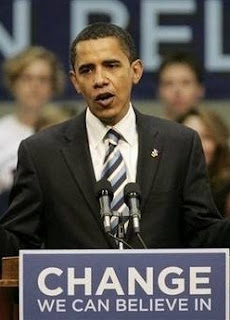
Further, Mr. Obama and his administration brazenly betrayed a commitment made last year by congressional Democrats to allow members of the Bush administration implicated in illegal surveillance (wiretappings and email interception, mostly) to be prosecuted. When called up on this promise, the Obama administration not only declared that they would not be allowing any of these lawsuits to go forward, they also added that in the future, lawsuits against the government on the grounds of illegal surveillance will be prohibited, unless the government openly disseminates your phone bills itself. By that point, though, I'll already be applying for jobs at Minitruth. 

There is yet hope, though. the outrage that Obama's attitudes has provoked has been vigorous and healthy, and decidedly bipartisan. If anything, Obama's campaign worked too well. You can't base a campaign on reigniting the electorate's interest in politics unless you're actually ready for them to actually be interested in what you do. Thankfully, closing Guantanamo Bay wasn't a salve strong enough to mask the creeping stains of the rest of the administration's actions.

"Change can't just be a slogan" - Barack Obama, 2007 

Sunday, 5 April 2009

This Also Happened

Because Italy embarrassed itself far more this week than I could go over in one Politic Blunder 
feature, a follow-up post was needed. 

At a NATO summit earlier this week, PM Berlusconi (pictured left talking on his mobile instead of being a Prime Minister), refused to acknowledge German Chancellor Merkel and the rest of the most powerful men and women in the world who were waiting for him to make a symbolic walk across a symbolic bridge to symbolically meet French President Sarkozy, symbolising the enduring importance of symbolism in politics. 

Mr. Berlusconi is on record claiming that he definitely wasn't talking down his cracked out transexual prostitute on the phone.

Update: I've been told to make clear that Mr. Berlusconi claims he on his mobile in negotiation with Turkish PM Tayyip Erdogan, trying to get him to accept Danish PM Anders Rasmussen as Secretary-General of NATO. If this is confirmed, it will make his actions misplaced and arrogant, but less so.

Italy also embarrassed itself by throwing a clueless fit about the new law in Afghanistan which essentially legalises marital rape. Terrible though this law is, Italy has completely missed the point by threatening to withdraw all female troops from its operations in Afghanistan (pictured left: the comeliest of these troops). The problem with this is that the Italian military clearly didn't think it was realistic to remove all its troops from Afghanistan. The implication is therefore that the female troops are sufficiently expendable that withdrawing them to make a point about women is a feasible option. It's incoherent and entirely inappropriate.

If you want to make a point, Italy, do it like a normal country. Please?

A Politic Blunder Feature: G20 London


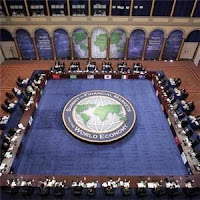
The G20 Summit here in London finished two days ago, amid much feigned interest, mild controversy and even milder actual interest. Almost the textbook definition of what is normally considered a stereotypical political talking shop, by virtue of the extraordinary circumstances, was actually a fairly big deal. 
                                            
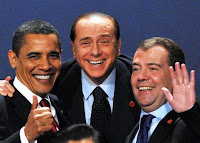
The festivities (no, wait, what's the opposite of festivities?) took off in style with President Obama meeting Queen Elizabeth II, and soliciting his wife to manhandle her. Thereafter Mr. Berlusconi made a fool out of himself by doing his best Little Rascals face between Mr. Obama and Mr. Medvedev, seen left gesturing wildly at their respective secret service snipers. 

The actual summit was surprisingly productive. The focus was more on saving capitalism rather than reforming it. Lots of money was given to the IMF (amounting to about $750 billion) ostensibly to pass on to developing countries in loans. Fantastical amounts of money were accounted for fiscal expansion (that is, the government spending more money on programmes and projects, often to create jobs where the private sector is cutting them), amounting to over $5 trillion. 

Talk of actually reforming the financial system was thin on the ground, with resolutions to begin to monitor "systemically important hedge funds", and to begin to regulate excessive leverage. There wasn't much commitment on international standards on finance either, beyond a token dictum on the importance of "internationally agreed high standards", and changing the name of the Financial Stability Forum (FSF) to the Financial Stability Board (FSB), which will have the exact same members, with no indication of any specific change in function. 

In terms of politicking, in brief: The USA wanted less regulation and more funds to support fiscal expansion, Europe wanted more regulation but dragged its feet on the money. The G20 was very shrill about its commitment to the developing countries, presumably to make up for the fact that no strategically unimportant poor countries were allowed to attend. 

Everyone agrees that the world is going to hell in a handbasket for one reason or another (This man's been predicting it with frightening regularity and speed for a while now). This is exactly why the G20 summit was a good thing, and why it's important that people recognise that it is a good thing. 

Expanding the realm of substantive international policy-making from the G7 to the G20 is a wonderful thing, even if there is still an enragingly long way to go. Conferences such as these actually work, too. Pledges were made, and though they probably won't be followed through on completely, funds will be raised and legislation will be written. Politics isn't a technical exercise, there are hundreds of degrees between failure and success, and it's in those spaces that progress is made. This isn't rocket science. It's much harder.

Tuesday, 24 March 2009

Where Is Your God Now, Mortal?

Two Tunisian pilots were today sentenced to 10 years in prison because of their actions in a 2005 plane crash off the coast of Sicily which resulted in the deaths of 19 people (pictured left). 

The pilots, flying for Turkish Airlines, prayed to their god instead of taking essential emergency measures before the plane crashed in the sea. They managed to emerged unscathed, and waited with the rest of the survivors on the wings of the plane for rescue.

Two things could have happened. Their god could have heard their loud and frantic prayers before the crash and saved their lives, whilst condemning the most wicked 19 passengers on the jet to a premature death and a quick trip to fiery oblivion. Or the gross negligence displayed by two pilots charged with the duty to keep passengers safe could have resulted in up to 19 unnecessary deaths.

A Politic Blunder feels that mandatory atheism might be a good idea for all jobs where mindlessly jabbering prayers could interfere with the execution of one's duties and place other people's lives at risk. But that might just be the rage and disgust talking.

Monday, 23 March 2009

Actually No Joke

A Politic Blunder is now on video!

Here's a video from Fox News's late night show "Red Eye" that reduces the American tendencies towards belligerence, homophobia, ignorance and arrogance to a 4:24 video (that's 1:06 per trait).


The video's already been heavily criticised in the rest of the world, so I'm posting this video not to anger my reader(s), or provoke derision, but to inform them that the kinds of attitudes long since consigned to satire and leering sarcasm in the rest of the world still actually exist in the USA. Which is the opposite of what Fox intended.

Sunday, 22 March 2009

BBC Boycott Collapsed After 56 Days, Drunken Revelry Reveals

After 56 days of seemingly intransigent boycotting of the BBC over the scandalous treatment of the Disasters Emergency Committee in January, it emerged yesterday that A Politic Blunder's editor-in chief on two separate occasions broke the boycott by viewing bbc programming on their iPlayer website.

The information came to light at The White Hart, in Bethnal Green, on Saturday night, when a drunk and bellicose Giorgio Mariani admitted to stunned onlookers that he had viewed Stewart Lee's Comedy Vehicle, aired on the previous Monday. It was also revealed that Mr. Mariani had also viewed another programme, a BBC Three pilot show by Japanese comedy duo Gamarjobat.

Other allegations now include an accidental visit to a BBC news website, which may have lasted up to 5 seconds. 

A Politic Blunder has admitted its mistake, and promised to review its boycott of the BBC in light of the revelations and the ongoing quality programming on the BBC. 

The BBC has declined to comment on the unfolding situation. 

Saturday, 21 March 2009

Hopefully Not Just Hazing

One of the good things to come out of the shameful Malagasy coup over the past week is news that the African Union has stepped up and suspended Madagascar pending the relegitimation of its government.

The AU gets an incredibly bad rap, mostly known for its anaemic efforts in the Darfur crisis. It's a new organisation, founded out of the Organisation for African Unity in 2002, and it's also composed of some of the worst basket-case countries the world has ever seen.

However, it does manage to regulate and organise the activities of some important institutions, like the African Development Bank, the regional equivalent of the World Bank, and it supports a lively debate on the possible benefits of economic and political integration for the chronically poor and war-torn continent. 

The point is that African states genuinely like being part of the AU, and when the AU suspends countries like Madagascar, Mauritania and Guinea(all in the hands of dictators following coups over the last year), it's a real disincentive for incoming autocrats. In 2005 following a coup in Togo, AU pressure caused Gnassingnbe Eyadema to call elections (which he then rigged and won anyways. Sigh.).

A Politic Blunder is increasingly desirous of a grading system, wanting to nominate the AU "Problematic but Progressive".

A New Challenger!

Obsequious, sniveling new dictator on the block Andry Rajoelina (pictured left demonstrating his new "free lap dances for all" populist claim) has taken power in a coup as publicised as it was wrapped in euphemism. The demagogue, known for his open incitements to violence against the government of former president Marc Ravalomanana, was given power on Tuesday by the Malagasy army after it took control of the country.

Newspapers as prestigious as Reuters and the Herald Tribune are quoted as saying "critics are calling it a coup". 

This demonstrates a fundamental lack of understanding of the word "coup". Mr. Rajoelina has become president, unelected, after the army mutinied and forced the incumbent out of office. Calling Mr. Rajoelina's takeover a coup is not an act of criticism, it is a statement of fact. 

Following his coup, Mr. Rajoelina desperately tried to brown-nose Europe and the USA by insisting that he would follow free-market economics and that he would "respect financial orthodoxy", in essence reassuring observers that he was more interested in stealing from his own people than from foreign investors (This is why I called him out as a sniveling sycophant in the first paragraph).

If A Politic Blunder had a grading system, it would invent a new category called "Turd-gimp" for Mr. Rajoelina.

Monday, 16 March 2009

Please Don't Go!

I literally haven't got the time to write anything reasoned or current at the moment, as I'm heavily engaged with essays, very much like this picture taken several years ago, only with different clothes and more facial hair.

Check back again this weekend for a revolutionary article about why higher education is ruining this country. 

Monday, 9 March 2009

Meeting Them Halfway

More news from Bangladesh this week, although seemingly much less significant than the mutiny that happened last month that left dozens killed (quite contrary to my early estimates of "23 max"). The Bangladeshi government has decided to temporarily ban YouTube after a video was posted with the audio of a meeting between PM Sheikh Hasina and her advisors. The meeting concerned whether or not Hasina should have negotiated with the mutineers, a decision made much more controversial recently by the discovery of a mass grave containing over 50 police officers' corpses. 

Concerning the banning of YouTube, the Bangladeshi Telecommunications Commission chairman, Zia Ahmed, stated:
"The government can take any decision to stop any activity that threatens national unity and integrity"
This statement, and its attendant attitude, is really not very befitting of an ostensibly democratic country. The mutiny was clearly a tragedy but the process of dealing with the criminals involved should have been open from the start. Conducting the meeting between Hasina and her military advisors in the open would not have compromised state security in any way, and thus the decision to ban YouTube following the leakage of an audio clip was not warranted.

Banning the circulation of information is one of the most serious things a government can do, and it should only be engaged in when not doing so would result in a serious threat to people's lives. Protecting the popularity or dignity of a mistaken Prime Minister is not such an occasion.

For those of you who are reading this, live in a country that respects the free media, and who also understand and desire to listen to angry arguments in Bengali (an admittedly small intersection), the links for the audio clips that brought YouTube to its knees (in Bangladesh) are here and here. 

For those of us who live